13.8 acres. One long-term plan. And a lot of work to get here.
Acre 13 didn’t really start with a building plan.
It started in late 2017, when I began the process of buying 13.8 acres of wooded land in rural New Brunswick.
At the time, I had a pretty simple goal: own a piece of land that I could eventually build on and make my own.
The plan was to pay the property off within five years.
To make that happen, I worked wherever I could. I ran my knife shop, worked in leather, and did commercial cleaning at night. It wasn’t glamorous, and there wasn’t much downtime, but the goal was worth working toward.
And I managed to get the property before the recent real estate boom completely changed the landscape.
Why 13.8 Acres?
There’s a bit of a story behind the name Acre 13.
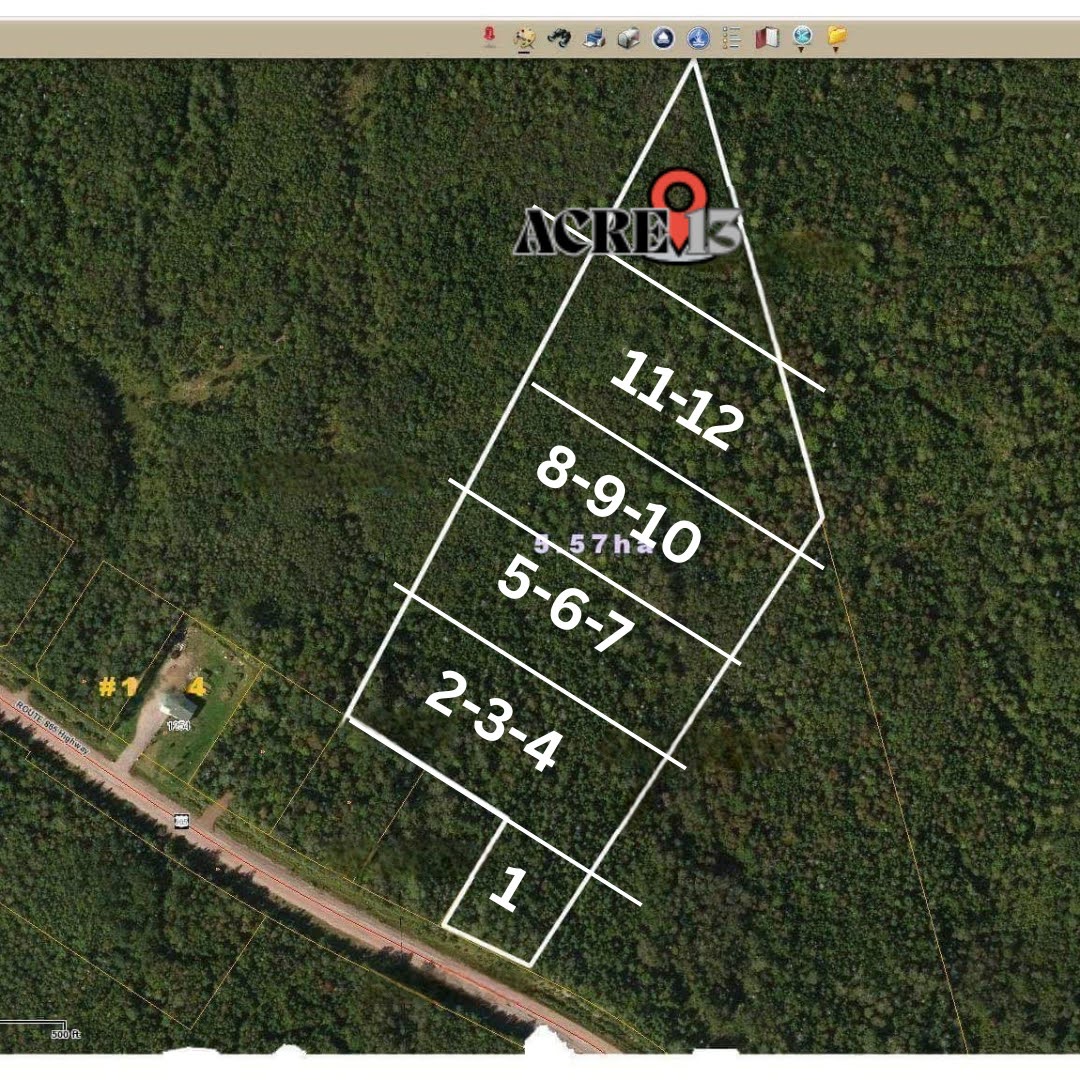
The property is 13.8 acres, but the idea is to eventually build on roughly the 13th acre.
That leaves approximately 1.8 acres for the actual build site, while the rest remains wooded.
The property itself is an odd shape, which makes planning interesting. But I actually like that.
I’m not looking to clear 13 acres and build a subdivision.
I want to build something in the woods, not instead of the woods.
Clearing Without Wasting the Forest
Even the areas that eventually have to be cleared will have a purpose.
As pathways and larger garden areas are opened up, the plan is to turn those spaces into a forest garden rather than simply removing trees and leaving open ground.
Fruit trees will be planted around the perimeter of cleared areas. Raspberry and blackberry arches can form living boundaries and pathways. Grapes will have a place in the garden as well.
The idea is to make the transition between forest and garden productive.
If we’re going to remove trees to create access, gardens or building areas, I want those spaces to give something back.
Clear only what we need. Make what we clear productive. Keep as much forest as possible.
That’s going to be one of the guiding principles of the property.
Then COVID Changed Things
The property was purchased before COVID, but during the pandemic a municipal rezoning process changed things.
The property ended up just inside the village limits.
That meant there were suddenly bylaws, regulations and planning requirements to work through—things that weren’t necessarily part of the original vision.
Fortunately, this is still rural New Brunswick.
I’m not dealing with the same restrictions or development environment you’d find in a major urban area, but there is still plenty to figure out.
So that’s become another part of the project: learning what I can and can’t do, figuring out the regulations, and finding ways to work within them rather than fighting them.
Getting Closer to the Land
Another big change happened when we moved.
We moved from one city to another primarily because of my wife’s work, but it had an unexpected benefit for Acre 13.
I went from being roughly 130–140 kilometres away from the property to about 55 kilometres away.
That’s a pretty significant difference.
Instead of spending hours just getting there and back, the property became much more accessible.
The smaller city about 15 minutes away has most of the things I’d need on a regular basis, while Costco and the bigger city are about 40 minutes away.
That means I don’t expect to be making trips into the big city very often once the property becomes more of a home base.
The idea is to have what I need nearby—and spend the rest of my time out here.
It Wasn’t Always About Buildings
One of the first things we did after starting the property was plant.
We put in two multi-variety apple trees and two multi-variety pear trees.
They took surprisingly well.
They blossomed, and the following year we actually had some apples and pears starting to form.
Then the deer discovered them.
That second winter, they absolutely decimated the trees.
It was one of those early lessons that comes with trying to develop land in the woods.
You can make plans.
Nature gets a vote.
The trees were a small thing in the overall scheme of the project, but they represented something bigger: the idea that this property wasn’t just going to be a place to build a structure.
It was going to become a place to live.
May 2023 — Everything Changed
On a Tuesday, my doctor officially put me out on disability because of my neuropathy and degenerative disc problems.
Two days later, on Thursday, I made the final payment on the property.
After nearly five years of working toward it, Acre 13 was finally paid for.
And suddenly, the two things I’d been working toward and worrying about for years had collided.
The land was ours.
And I had time.
My wife has a saying that comes up whenever we talk about it:
“Be careful what you wish for.”
For years I’d been saying, I wish I had more time to spend at the property.
Well…
Now I have all the time in the world.
It wasn’t exactly the way I imagined getting it.
But sometimes life doesn’t ask how you want the next chapter to begin.
It just opens the door.
And that’s really when Acre 13 started becoming more than an idea.
Working With What the Land Gives Us
The property also has another advantage: its orientation.
It’s generally south to southwest facing, which gives us good solar exposure and, importantly, plenty of winter sun.
That fits nicely with the off-grid direction we’re taking.
We already have solar panels, and we have a wind turbine setup.
The thinking is that the two systems can complement each other.
When the sun is shining, solar does the work.
And here in New Brunswick, when it’s not particularly sunny, there’s a pretty good chance we’re getting some wind.
That’s where the solar/wind hybrid system starts to make sense.
Rather than relying on one source of energy, the goal is to build a system around the conditions the property naturally provides.
The Property Today
The property is almost entirely wooded.
The driveway is already in, thanks to the previous owner, and the culvert is in as well.
That gives me a starting point without having to begin completely from scratch.
Over the years, I’ve spent a lot of time thinking about what I actually want to do here.
And the vision has evolved.
The goal isn’t to build the biggest house I can afford.
It’s not to create a traditional suburban property in the middle of the woods.
The goal is to become as self-sufficient and off-grid as realistically possible.
Water collection is next on the list.
Food production will be integrated into the landscape.
Power will come from a combination of solar and wind.
And wherever possible, the systems will work with the land rather than against it.
So Why Acre 13?
Because this isn’t going to happen overnight.
This has already been almost a decade in the making.
There have been changes in plans, changes in location, changes in regulations, plenty of work, and more than a few setbacks.
But the property is still there.
And the plan is still there.
13.8 acres.
Build on Acre 13.
Keep the other 1.8 acres for the build site.
Clear only what we need.
Grow where we can.
Generate what we can.
Build with the land instead of fighting it.
And slowly turn a piece of wooded New Brunswick into something that is increasingly self-sufficient, increasingly off-grid, and eventually—home.
Maybe I didn’t get the extra time at the property in the way I had wished for.
But I got it.
And now I’m going to see what I can do with it.
This is where Acre 13 begins.